---------VG TRAVEL CLUB PRESENTS YOU VACATION-GREECE.COM---------

VG TRAVEL CLUB JOIN THE CLUB ADD YOUR HOTEL
TERMS OF SERVICE HOW TO BOOK VACATION IN CYCLADES

---------YOUR TRAVEL GUIDE IN GREECE AND THE GREEK ISLANDS---------


HISTORICAL ELEMENTS

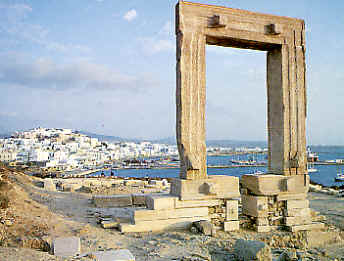
View of Naxos Town from the Temple.

The Temple of Apollonas in Naxos Town.

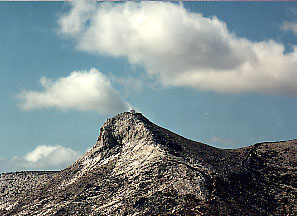
The threads which link mythology to the island of Naxos are many. Zeus (the father of the gods), Semele, Dionysus, Ariadne, Demeter, Persephone, Iphimedeia, Pancratis, the giants Otus and Ephialtes are but a few of the names that figure in the action-packed legends surrounding the island. The people of Naxos worshipped Zeus the Melosios, protector of the flocks, and a temple was erected by the faithful in his honor on Mount Zas, which took its name from Zeus. The inscription "Mountain of Zeus the Melosios" can be seen carved on a rock there.

According to legend, the father of the gods was born in Crete but grew up on the island of Naxos, from where he set out to gain his Olympian throne. Another epithet ascribed to him is Zeus Eubouleus, protector of the Naxians. Zeus, then, according to this myth, fell in love with Semele, daughter of King Cadmus of Thebes, and from their illicit union sprang Dionysus, god of wine and revelry. Urged on by Hera, Semele asked Zeus to appear before her in all his divine majesty. However, being a mere mortal, Semele was unable to withstand the volley of thunderbolts which accompanied the king of the gods, and she was literally thunderstruck and died before giving birth to her child.

Zeus seized the foetus and stitched it up inside his thigh. When the time came for him to be born, Dionysus emerged from his father's thigh on the island of Naxos and was entrusted to some local nymphs, Filia, Coronis and Cleidi to nurture him and bring him up. Dionysus thus grew to love the island which had fostered him and used his divine power to make it a fertile, happy place, bestowing upon it the rich vineyards that produce the island's plentiful supplies of excellent wine.

Another myth tells us how Theseus, returning from slaying the Minotaur in Crete and bringing with him Ariadne, the daughter of King Minos, stopped off at the island of Naxos. There he had a dream in which Dionysus ordered him to depart alone from the island, leaving Ariadne behind, and, fearing the wrath of the god, Theseus did as he was told. Dionysus then abducted Ariadne and took her off to Mount Drios. The union between the god and the mortal resulted in the births of Oenopion, Staphylus and Evadne. According to P. Decharme, there were two Ariadnes: one of them was abandoned by Theseus on the island of Naxos where she died, and the other was the wife of Dionysus. The rites carried out in memory of the former are all ceremonies of mourning, whereas the celebrations connected with the second Ariadne are all accompanied by hymns of triumph. The people of Naxos used to hold an annual ceremony called the Dionysia, which included sporting events and sacrificial rites.


The wealth of finds brought to light by the archaeological excavations that have been carried out for many years now, in a tireless attempt to uncover all the treasures of the past, indicate that Naxos was the most important center of the Cycladic civilization (4000 - 1000 B.C.). Traces of a Cycladic settlement have been discovered at "Korfari ton Amygdalion", not far from Panormos, and a major settlement of stone-built houses has been found at Grotta. Among other items also discovered were funeral gifts from tombs dating from the Cycladic period made of copper, silver and gold, various pots and vessels, marble utensils and implements made out of wood, stone and copper.

delos.jpeg (25164 bytes)

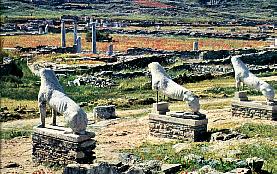
Terrace of Lions in Delos.

The findings most representative of this period, however, are the splendid Cycladic figurines, marble statuettes of the human form, with simple, austere lines that show a singular sensitivity. The island's first inhabitants were the Thracians and the Pelasgians, followed by the Carians from whose leader, Naxos, the island took its present name. In ancient times, the island was known variously as Dia, Strongyli and Dionysias.

During its history, the Ionians from Attica settled on the island and a major civilization developed there. The islanders became a force to be reckoned with. Emissaries were sent to colonize Arkesini and Aigiali on Anafi; close links were maintained with Santorini and Chalkis, and later (7th century B.C.), the islanders were involved in clashes with Milos and Paros, and it was in a battle with the Parians that Archilochus, the great lyric poet of the time who hailed from Paros, was killed.

The power and wealth of the island and its flourishing arts, especially sculpture, can be seen in the lavish offerings made by the people of Naxos on the sacred island of Delos, which include the house of the Naxians, the Stoa of the Naxians, the Terrace of the Lions, the statue of a woman dedicated by the wealthy Naxian lady Nikandra, which is now housed in the National Archaeological Museum in Athens and the Colossus of the Naxians.

The island was ruled by aristocrats and the ruling classes were called "pachis".

zas1.JPG (28484 bytes)

Mount Zas


In 501 B.C., Naxos suffered its first attack by the Persians, but managed to drive them back. However, in 490 B.C. the Persians launched another attack, this time successfully, and installed a pro-Persian regime on the island. During the wars between the Greeks and the Persians, the people of Naxos fought on the side of the other Greeks at Salamis and Plataea. In 479 B.C. Naxos joined the Delos Alliance, but left it again in 466 B.C. For a time, the island came under Athenian rule, but when the Athenians were beaten by the Spartans in the Peloponnesian War, the Naxians fell under Spartan rule. In 376 B.C. the island came once more under the influence of Athens, later to be annexed by the Macedonians, the Ptolemies of Egypt and the Rhodians. In 41 B.C., following the fate of the other island of the Cyclades, Naxos fell subject to the newly acquired power of Rome.

Christianity spread quickly to the island. Initially Naxos was ruled by the Church of Rhodes, but in 1083 it became the seat of the Metropolis of Paronaxia. In 1207 the Venetian, Marco Sanudo, conquered the islands of the Cyclades and established the Duchy of the Aegean, with its headquarters on Naxos. For six weeks the islanders held out valiantly against the Venetians, barricading themselves inside the old Byzantine fortress at Apalyros, but finally had to admit defeat. Sanudo built a strong fortress and divided the island into 56 provinces which he shared out amongst his officers. The Duchy remained a powerful force for nigh on three centuries. In 1564 the island was conquered by the Turks, but the administration remained, to all intents and purposes, in the hands of the Venetians, the sole concern of the Turks being to collect taxes. Indeed, it is said that the Turks' fear of the Greeks and of pirates was so great that very few actually lived on Naxos; consequently Turkish influence on the island is virtually non-existent.

In May, 1821 the island was liberated after courageous fighting on the part of the Naxians. With the signing of the protocol of 3rd February 1830, Naxos became part of the newly-formed Greek state, and from then on was to follow the same fate and further struggles as the rest of Greece.


Rent a car or motorbike. Our personal opinion. Cyclades Album. Guest book


BACK TO CYCLADES        /        NAXOS ISLAND HOTELS


VG - Travel Club - Agiou Tryfona 15, 152 36, Palaia Penteli, Athens, GREECE

Tel: +30210-8047244, +30210-8104389, Fax: +30210-6131148, e-mail: greece@vacation-greece.com