| ---------VG TRAVEL CLUB PRESENTS YOU VACATION-CYCLADES.COM--------- |
|||||||||||||||||||||
|
|||||||||||||||||||||
| ---------YOUR TRAVEL GUIDE IN GREECE AND THE GREEK ISLANDS--------- |
|||||||||||||||||||||
|
|||||||||||||||||||||||||
HISTORICAL ELEMENTS
In mythology, Kea was known as Hydroussa, the favorite place of the Nymphs, which used to live near the numerous springs in the forests. This period came to an end quite violently, when a terrifying lion appeared in the mountains and chased the Nymphs who, seeking safety, found shelter in the northern coast and from there escaped opposite to Karystos. The consequences were disastrous for the island. The waters diminished desperately and the vegetation disappeared. The island was heading for decline and catastrophe. It was Aristaios the semigod, the son of Apollo and nymph Kyrini, who was asked to help by the inhabitants. Offering sacrifices to Ikmaios Zeus, the god of rain, the propitiation of goods soon yielded. |
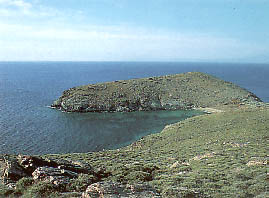
The historic peninsula of Kefala which was thought to be identified with the ancient peninsula of the Lion. |
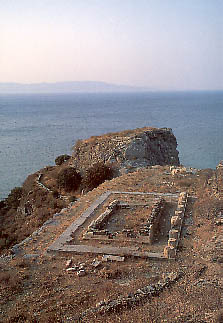
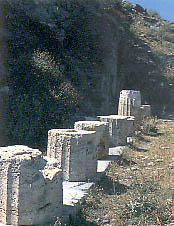
The acropolis of Karthaia.
|
PREHISTORY
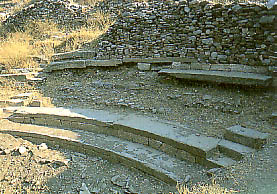
Part of the ancient theater in Karthaia. |
CYCLADIC CIVILIZATION - MINOAN & MYCENAEAN CIVILIZATION The early signs of organised life in Kea come from the 4th millenium B.C., at the end of the Neolithic Age and the outset of the early Bronze Age (Bronze-Stone Age). On the north-west coastline of the island between the bays of Agios Nikolaos and Otzias, over the small rugged Kefala peninsula - on one side of which a natural port is formed - a cemetery and a settlement of 3300-3200 B.C. was found. This immemorial cemetery forms "the first testimony of systematic burial" in the entire Aegean Sea. |
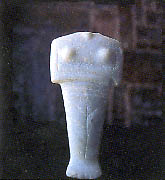
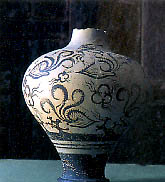
Marble cycladic statuette, found in Agia Irini. |
|
Not far from this position in the small peninsula of Agia Irini, deep in the bay of Agios Nikolaos, a new settlement of the early Cycladic period was formed in the 3rd millenium B.C., as a natural evolution of the civilization of Kefala residents. Afterwards, this position was fated to imprint on history and the early civilization of the Aegean Sea for over 1.500 years. Since the 16th century B.C. Kea had served as a link of communication and intervention between the Minoan and the new Mycenaean world. During this period, an impressive change of the settlement into a Minoan and Mycenaean center takes place. The position of the island over the main sea route that joins Central and Northern Greece with the western coastline of Asia Minor, Northern Aegean and Crete, combined with the natural safety of the port, contributed to its development: economic and social prosperity, waterworks and other great technical works of Mycenaean type, decorations with variety of forms and motives on the works of art (a reminder of their counterparts of the same period in Thira and Milos). |
||
|
||
The Classical Period (5th - 4th century B.C.) showed a new rise in merchant - shipping and the port of Karthea competed in acme the one of Korissia. That seems to have happened due to the development of Pireas by the Athenians. Up to this time the island depended on Evia and Attika, but it started now having relationships with most of the islands in the Aegean Sea. Export activities increased due to the considerable acme in the wool industry, vine culture, textile industry and the mining of perfect quality miltos. |
|
HELLENISTIC PERIOD - The decline of the historic institution of city - states, which had already been well established by the end of the 4th century B.C., was not yet obvious in the island. The island and its cities as members of the "Common Unity of People of Islands" (314 B.C. and later) or later as Hellenistic possessions maintained the glory and strength of the Classical Times. The fatal decline of the city - states of Kea would be partly caused because of the gradual corroboration of the central governing of their descendants' states. This existing peril in Greek seas, the dangers of pirates or barbaric invasions led the inhabitants of the islands to accept the domination of powerful protectors - tyrants of this period. For over 100 years the island was at the historic stage when the conflicts between the Egyptian state of Ptolemaios and other descendants was in an apex. The port of Korissia was an important base for the Ptolemeans' nautical operation (after 267 B.C.) who dominated Kea for many years. |
Marble cycladic statuette, found in Agia Irini. |
After the reign of Antigonos Gonatas, to Ptolemaios detriment (258 and 245 B.C.) and while the invasions and looting became more frequent, the island entered into alliances of equality (mutuality of provision, political rights, trade transactions e.t.c.) with the Aitolians, who, at the time, were forming their League. After the intervention of Macedonian domination, the fate of Kea (during 203-202 till 167 B.C.) was controlled by the new ruler of the seas, Rhodes. Later on, under Rome's domination, the people of Kea and Athens co-operated in trying to keep their independence and identity. In 67 B.C. the Roman Pompeius had managed to restrict the pirates. Feeling obliged the people of Kea supportes Pompeius in his battle against Caesar (49-48 B.C.). |
|
|
THE BYZANTINE PERIOD |
Under construction... |
 accommodation |
kea island |
cyclades |
back to greece
accommodation |
kea island |
cyclades |
back to greece
 |
|
|
|
Greece accommodation - Greek islands - Cyclades - Greece AGIOU TRYFONA 15, 15236, P. PENTELI, ATHENS - GREECE - © 2009 |
|
| TEL.: +30 210 8047244, 8104389, FAX: +30-211 800 6006 - contact us | ||